On the evening of September 4, 2025, the 11th session of the “Linhu Think Tank International Distinguished Lectures” was held at the School of International Studies at PKU. George Katrougalos, former Minister of Foreign Affairs of Greece, Professor of Public Law at Democritus University of Thrace, and Vice President of the International Association of Constitutional Law, delivered a lecture entitled “Multilateralism in the Multipolar World.”
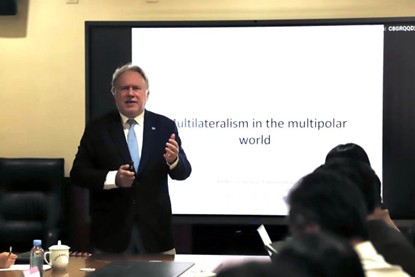
The lecture was hosted by Wang Dong, Professor, School of International Studies; Deputy Director of the Office for Humanities and Social Sciences, and Executive Director of the iGCU, Peking University. Attending the event were Zhang Yongle, Deputy Director of the Office for Humanities and Social Sciences and Tenured Associate Professor, Peking University School of Law; Professors Zha Daojiong and Ding Dou, School of International Studies, Peking University; Chen Shaofeng, Tenured Associate Professor, School of International Studies, Peking University; Lai Huaxia, Assistant Professor, School of International Studies, Peking University; and more than ten master’s and doctoral students from Peking University.
Professor Katrougalos noted that the current international order remains influenced by the legacy of colonialism and is characterized by significant structural inequalities. He noted that under the Bretton Woods system, developed countries hold the majority of voting rights in the International Monetary Fund and the World Bank, with the United States effectively possessing de facto veto power through the rules, while countries of the Global South have a weak voice in international financial governance. Meanwhile, they face the burdens of heavy debt and unfulfilled development aid commitments. At the same time, developed countries apply double standards in trade by erecting barriers in vulnerable industries, thereby exacerbating global economic imbalances. Issues of climate injustice and the digital divide are also prominent, with the Global South placed at a disadvantage in climate response and access to digital resources.
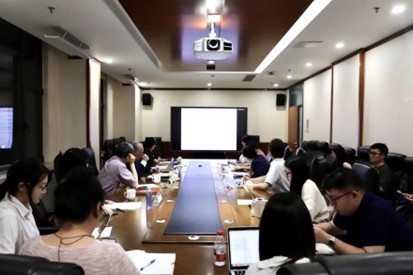
Although disparities between the North and South persist, Professor Katrougalos argued that American hegemony is gradually declining and that a multipolar international order is becoming the trend. He observed that the United States seeks to maintain its status through unilateralist policies, such as withdrawing from multilateral mechanisms and employing tariffs as a weapon. However, today’s highly interconnected global economy differs from that of the U.S.-Soviet Cold War era: tariffs can hardly provide the United States with long-term benefits, and Europe’s changing attitude toward U.S. policies also reflects the relative weakening of American power. Concerning the future of a multipolar world, he emphasized that it will not return to a bipolar structure. The four major initiatives advanced by China—the Global Development Initiative, Global Security Initiative, Global Civilization Initiative, and Global Governance Initiative—promote development through mutual benefit, without any intention of becoming a hegemonic power, while the practice of “diversified diplomacy” by various countries further confirms the development of multipolar trends.
During the discussion session, participants exchanged views on a wide range of topics, including the post–World War II international financial order, the current multipolar world structure, Greece’s positioning between the Global North and South, and whether moderate judicial measures can effectively resolve international disputes.
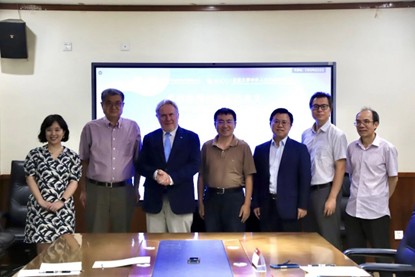
This session of the “Linhu Think Tank International Distinguished Lectures” provided in-depth perspectives for understanding multilateralism in a multipolar world. Katrougalos’s views revealed the core contradictions and transformation directions in current global governance: in the face of an irreversible trend toward multipolarity, only by upholding multilateral cooperation can a fairer and more equitable international order be built, injecting lasting momentum into global common development.
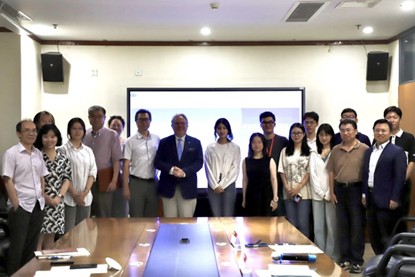
This event marked the 11th session of the “Linhu Think Tank International Distinguished Lectures” at Peking University, co-hosted by the Department of Social Sciences and Institute for Global Cooperation and Understanding, Peking University, and co-organized by the Office of Human Resources, the Office of International Relations, Media Convergence Center of PKU, and Peking University Press. It aimed to establish the “Linhu Think Tank” as a series of brand activities, promote the construction of an independent knowledge system in philosophy and the social sciences, enhance policy advisory capacity, and foster a sound research atmosphere for think tanks.






 Subscription