On November 21, the China Think Tank Research and Evaluation Center at Nanjing University hosted the “2025 New Think Tank Governance Forum.” Focusing on the theme of “Reviewing the Progress of New Think Tanks with Chinese Characteristics and Outlook for the ‘15th Five-Year Plan’,” the Forum gathered more than 500 experts and scholars from think tanks and academic circles nationwide for in-depth exchanges. The event showcased progress in building new think tanks with Chinese characteristics and further promoted the role of think tanks in advancing the modernization of China’s governance system and capacity.
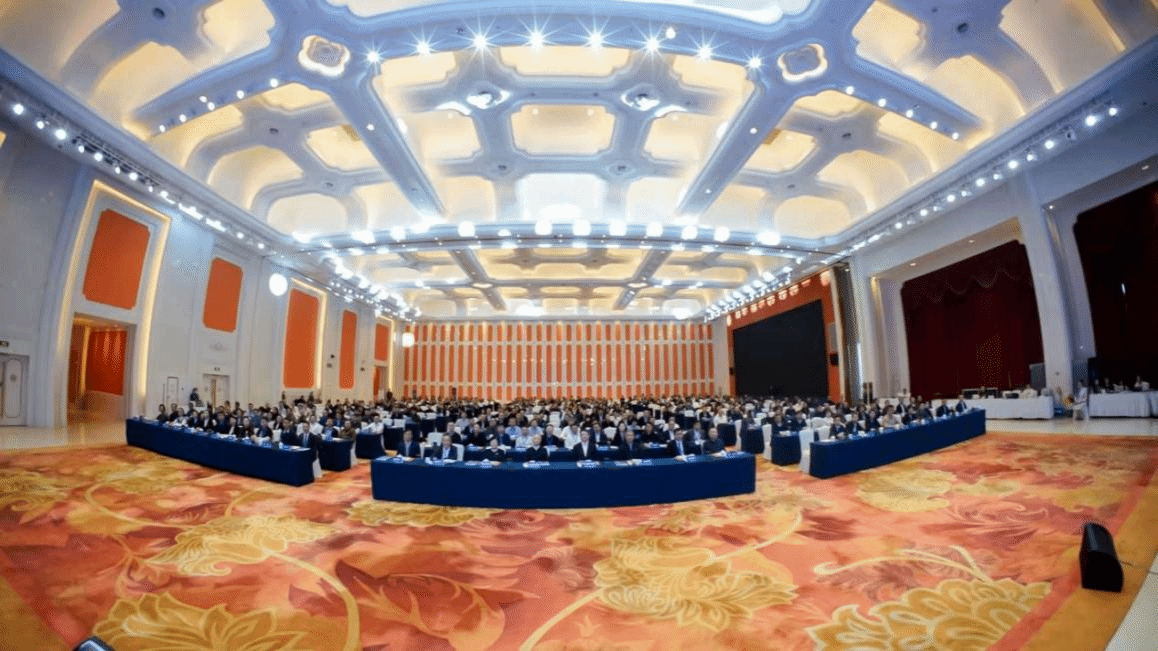
The venue of the “2025 New-Type Think Tank Governance Forum”
Since 2017, the Forum has released the annual Best Cases of Think Tank Development and Outstanding Think Tank Achievements under the China Think Tank Index (CTTI) for several consecutive years. In 2018, it released the CTTI Top 100 University Think Tanks for the first time, and then again in 2022. It comprehensively showcases the current situation and development of China's characteristic new think tanks, generating extensive social and professional influence.
This year’s Forum released the CTTI 2025 Top 100 University Think Tanks, as well as the results of the 2025 CTTI Best Cases of Think Tank Development and Outstanding Think Tank Achievements. As of November 2025, the CTTI system has included data from 810 university think tanks. Based on objective data concerning think tank “products”, “activity”, and “media impact”, combined with “expert evaluations”, comprehensive scores were generated, resulting in the selection of the top 100 think tanks with the best overall performance. The admission rate was approximately 12.3%, including 40 A+ think tanks (4.9% admission rate) and 60 A-level think tanks, with an additional 31 institutions receiving nominations.
A total of 367 submissions were received for the CTTI 2025 Best Cases “Benchmark Case” Award. In the end, 35 Benchmark Cases, 69 Demonstration Cases, and 103 Excellent Cases were selected. Meanwhile, 622 institutions submitted 1,014 research outputs for the 2025 Outstanding Think Tank Achievements, resulting in 91 Grand Prizes, 173 First Prizes, and 327 Second Prizes—setting new records in both submission volume and output quality.
The Institute for Global Cooperation and Understanding of Peking University (iGCU) was selected for the CTTI 2025 Top 100 University Think Tanks and received an A+ rating. In addition, iGCU’s submission “Smart City Forum” received the 2025 CTTI Think Tank Construction Best Case “Benchmark Case” Award. Its “2025 BRICS Smart City Ranking” won the Grand Prize for the 2025 CTTI Outstanding Think Tank Achievements, and its “2025 Global Space Infrastructure Review: Space Infrastructure Evaluation Oriented Toward Interstellar Connectivity” received the First Prize for the 2025 CTTI Outstanding Think Tank Achievements. iGCU has now consecutively received the CTTI Benchmark Case Award and Grand Prize for Outstanding Think Tank Achievements for four years.
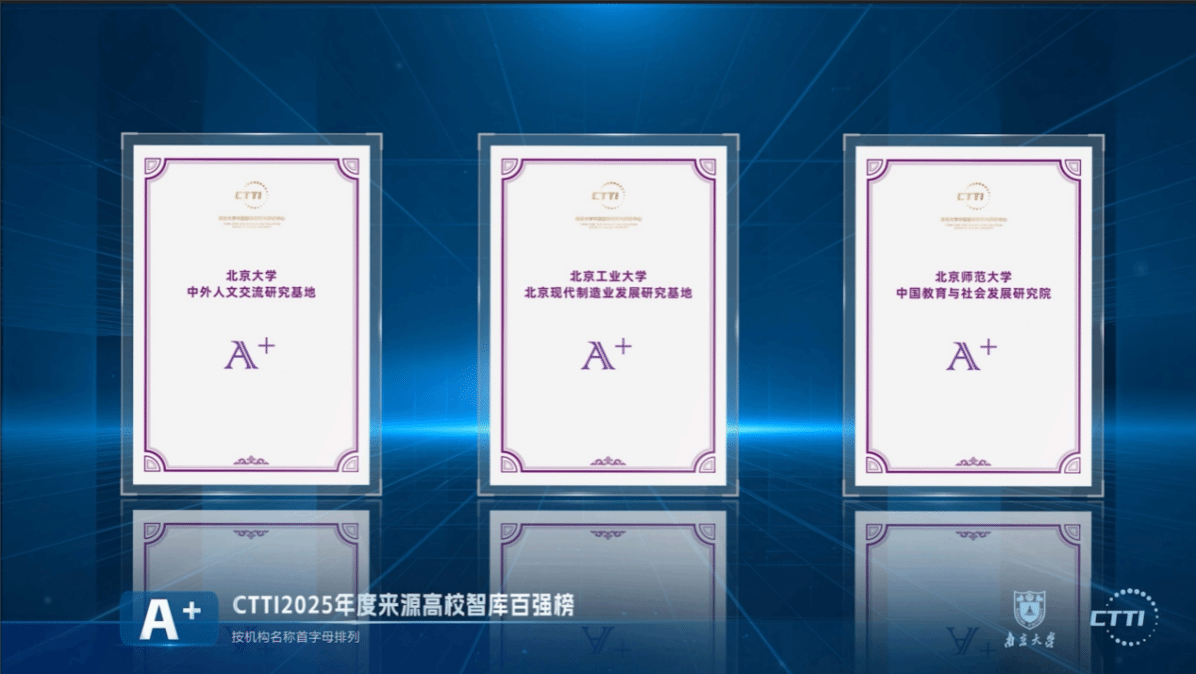
iGCU was selected for the CTTI 2025 Top 100 University Think Tanks and received an A+ rating
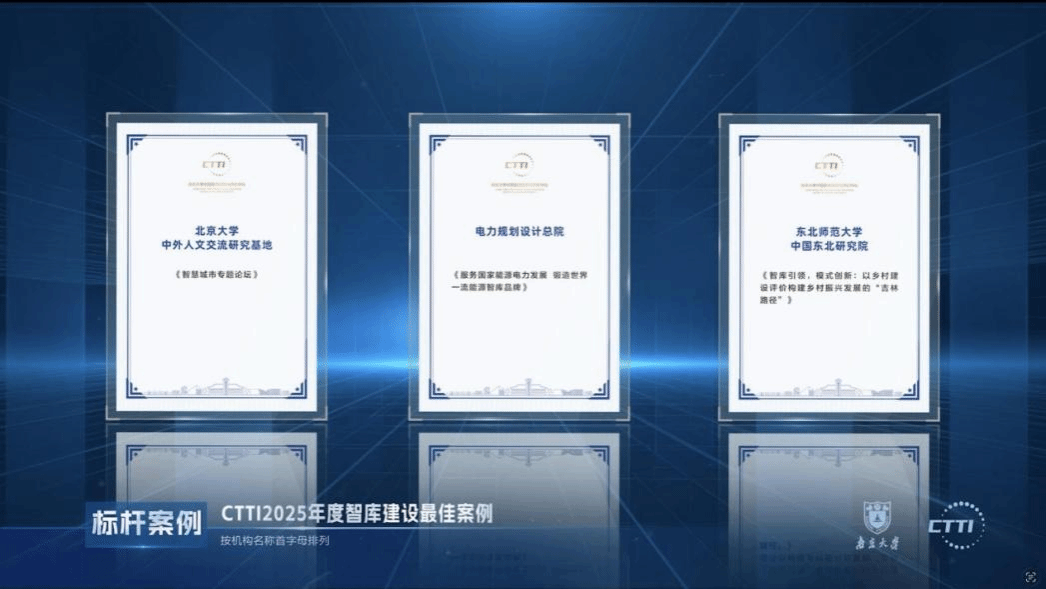
2025 CTTI Think Tank Construction Best Case “Benchmark Case” Award
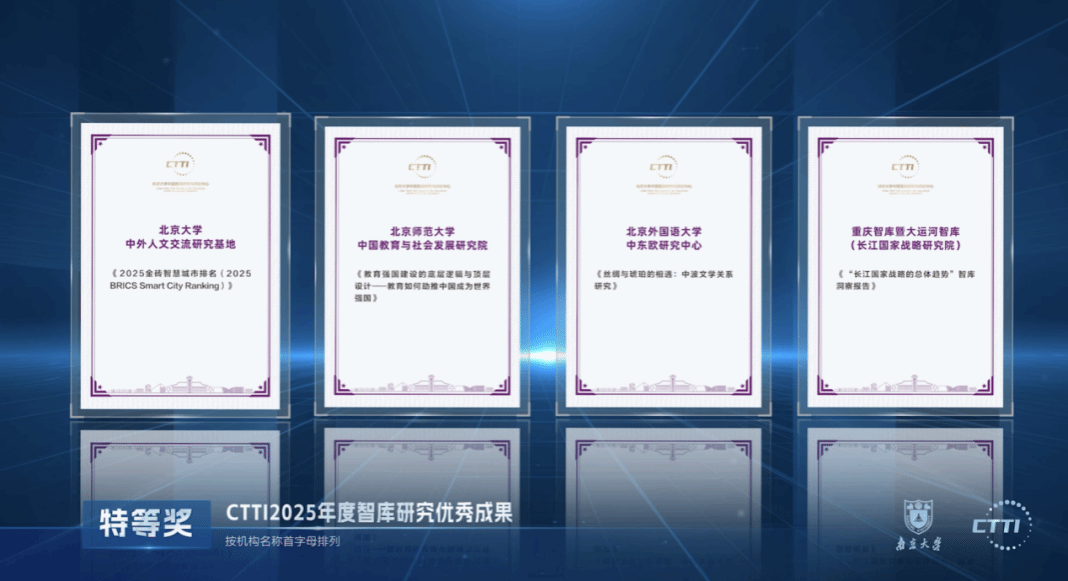
Grand Prize for the 2025 CTTI Outstanding Think Tank Achievements
First Prize for the 2025 CTTI Outstanding Think Tank Achievements
On September 13, 2025, under the framework of the 2025 China International Fair for Trade in Services (CIFTIS), the Institute for Global Cooperation and Understanding of Peking University and the Institute for Urban Internationalization Studies of Zhejiang International Studies University co-hosted the thematic forum “Building Smart Cities and Space Infrastructure in a Changing World” together with several universities and research institutions. The Forum convened top domestic think tank and researchers and released two influential reports: the “2025 BRICS Smart City Ranking” and the “2025 Global Space Infrastructure Evaluation”. This milestone marked China’s significant progress in proactively setting the global agenda and developing international evaluation standards, offering forward-looking “China Solutions” for global development. The forum not only served as a platform for cutting-edge intellectual exchange but also as a successful practice of international communication. Leveraging CIFTIS as a national-level channel, Chinese analytical capacity has achieved efficient and extensive global outreach, significantly enhancing China’s international discourse power and intellectual leadership in related fields.
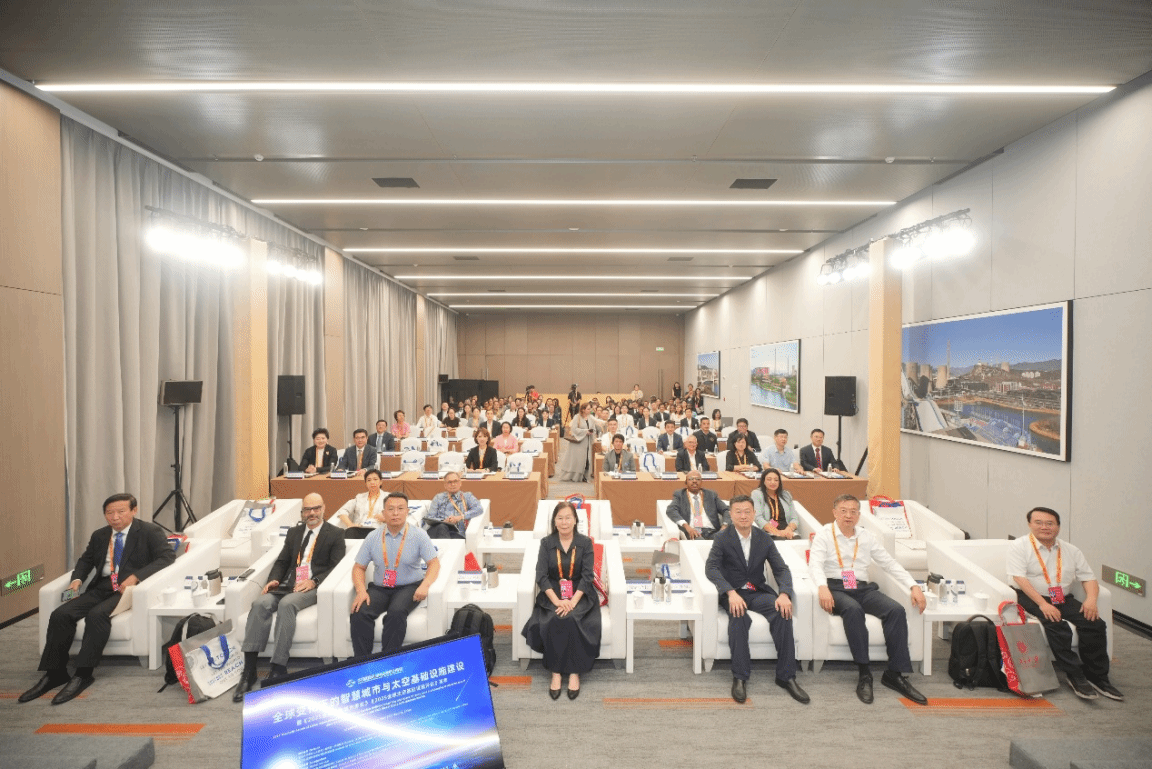
“Building Smart Cities and Space Infrastructure in a Changing World”
Group Photo of Guests at the Thematic Forum
The “2025 BRICS Smart City Ranking” report establishes 10 indicators across three major categories—digital infrastructure, traditional infrastructure, and institutional infrastructure. It invited 12 global experts from multiple fields to assign indicator weights and conducted systematic evaluations of 238 cities from BRICS countries and global benchmark cities, resulting in authoritative and credible rankings. The 10 indicators span multiple frontier domains, including Telecommunication networks (wired/wireless), AI and data centers, traditional transportation networks, smart transportation networks, energy, Internet, water ecosystems, public health networks, emergency networks, government service networks, and digital society. The report constructs a smart city evaluation framework oriented toward “regional integration” and multi-infrastructure synergy, offering clear and feasible pathways for BRICS cooperation and contributing a “Chinese Framework” and “Action Guide” to global smart city development.
The “2025 Global Space Infrastructure Review: Space Infrastructure Evaluation Oriented Toward Interstellar Connectivity” examines space infrastructure geared toward “interstellar connectivity,” and for the first time evaluates the space infrastructure of 43 global economies, analyzing the influence of aerospace technologies on humanity’s potential for space exploration. The report shows that the United States, China, and Russia dominate global space development and provides a forward-looking strategic framework for space exploration in the coming decades, revealing a global space development landscape led by “dual major powers”—China and the United States. Using nine dimensions—support, propulsion, transportation, energy, planetary surface communication, production, governance, civilization continuity, and great-power competition—the report integrates space engineering implementation with human civilizational governance for the first time, offering systematic guidance for global space exploration from 2035 to 2050 and presenting a panoramic view of current global space infrastructure development.
The Institute for Global Cooperation and Understanding (iGCU, formerly known as the Institute for China-US People-to-People Exchange) at Peking University is a cutting-edge think tank that integrates academic research, policy advising, and leadership training. The advisory board of iGCU consists of 30 former and incumbent Chinese state and ministerial level leaders, accompanied by more than 100 preeminent scholars and experts from a wide range of disciplines who serve as academic committee members and resident/non-resident research fellows. In order to fulfill its mission “Connecting People, Understanding the World” iGCU seeks to promote global cooperation and understanding by conducting innovative research and policy analysis.







 Subscription