On November 9, 2025, Pascal Lamy, former Director-General of the World Trade Organization, visited Peking University’s Guanghua School of Management to deliver a keynote speech, titled “Prospects of International Multilateral Trade System[1] ,” at the 12th Peking University Linhu Think Tank International Forum and the Guanghua “Dialogue with Masters” series. The event was chaired by Wang Dong, Deputy Director of the Office of Humanities and Social Sciences, Director of the Think Tank Office, Professor at the School of International Studies, and Executive Director of the Institute for Global Cooperation and Understanding, Peking University.
Following his speech, former Director-General Lamy engaged in a dialogue with Tang Yao, Deputy Director of the Center for Management Science at Peking University and Associate Professor at Guanghua School of Management’s Department of Applied Economics, and took questions from the audience during a Q&A session. Liu Qiao, Dean of Guanghua School of Management, participated in the event, alongside over 150 faculty members and students.

In his address, former Director-General Lamy provided an analysis of the profound transformations reshaping the multilateral trading system, including the following factors: geopolitical competition, vulnerabilities in global supply chains, and social inequalities stemming from globalization. He divided the globalization process into two distinct phases: the “era of rapid globalization” spanning from the 1970s to the early 21st century and the ongoing transition to “slow globalization.”
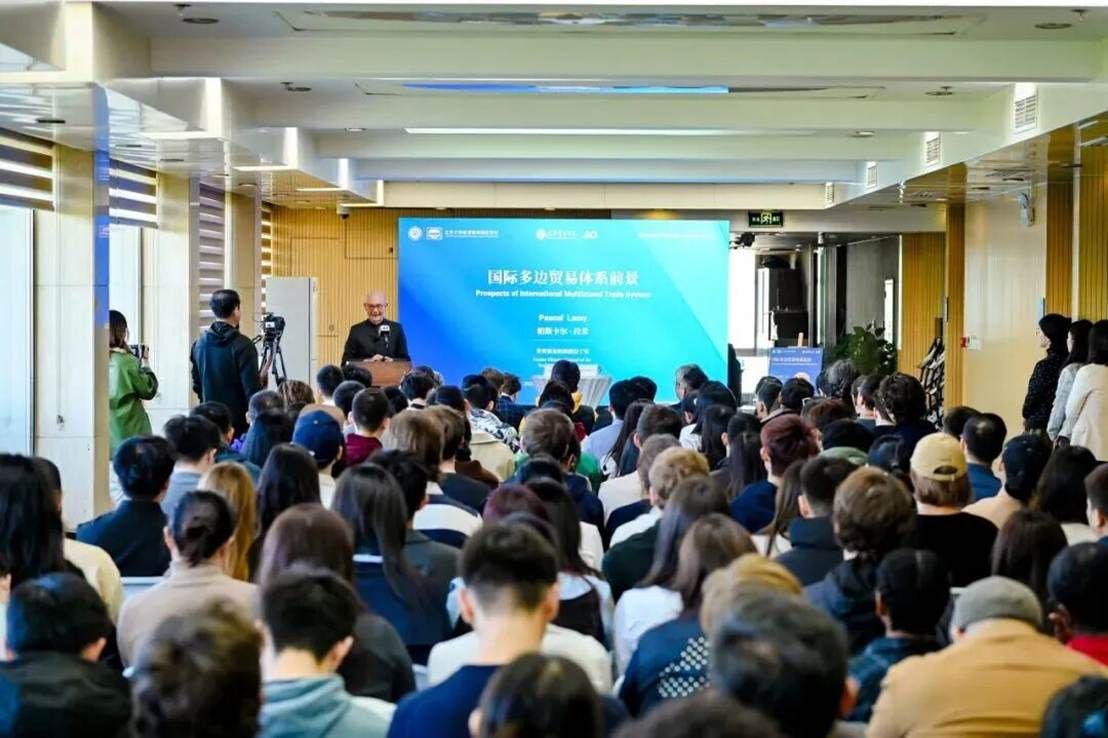
Lamy summarized the “new normal” of the current multilateral trading system through three defining characteristics: the “weaponization” of trade, U.S. protectionist policies, and the rise of “precautionary measures” driven by health and environmental concerns. He emphasized that despite these challenges, globalization has not ended but has entered a new developmental phase. Moreover, he discussed potential reforms to the multilateral trading system, proposing three recommendations: resolving the institutional contradictions facing the WTO, expanding coverage of emerging issues (e.g., trade, environment), and rebalancing the power structure between members and the Secretariat.
On China’s role within this system, Lamy stated that as a major trading nation with annual exports reaching $3.6 trillion, China should continue to advance macroeconomic structural adjustments, actively explore emerging markets, and promote global trade development through greater openness.

During the post-speech dialogue session, Lamy engaged in an in-depth exchange with Assoc. Prof. Tang Yao on various topics, including the outlook for global trade. The former Director-General stated that the current slowdown in trade growth reflects a structural rebalancing between “security and efficiency” and that the future multilateral trading system should incorporate more effective preventive practices, such as environmental protection.

During a Q&A session involving the audience, Lamy shared insights on several hot topics, including the possibility of the U.S. withdrawing from the WTO and the trajectory of China-U.S. trade relations. He assessed that a full U.S. exit from the WTO is unlikely, predicting that strategic competition between China and the U.S. will follow a pattern of alternating tension and détente. Lamy concluded by emphasizing that globalization is entering a new, more complex phase, urging nations to continue leveraging multilateral mechanisms like the WTO to safeguard the stability of the global trading system.
Leveraging his extensive practical experience in international trade, Lamy provided crucial insights into the evolution of the global multilateral trading system and offered valuable guidance for navigating global economic governance amid complex international dynamics.


Compiled by Song Xiao





 Subscription