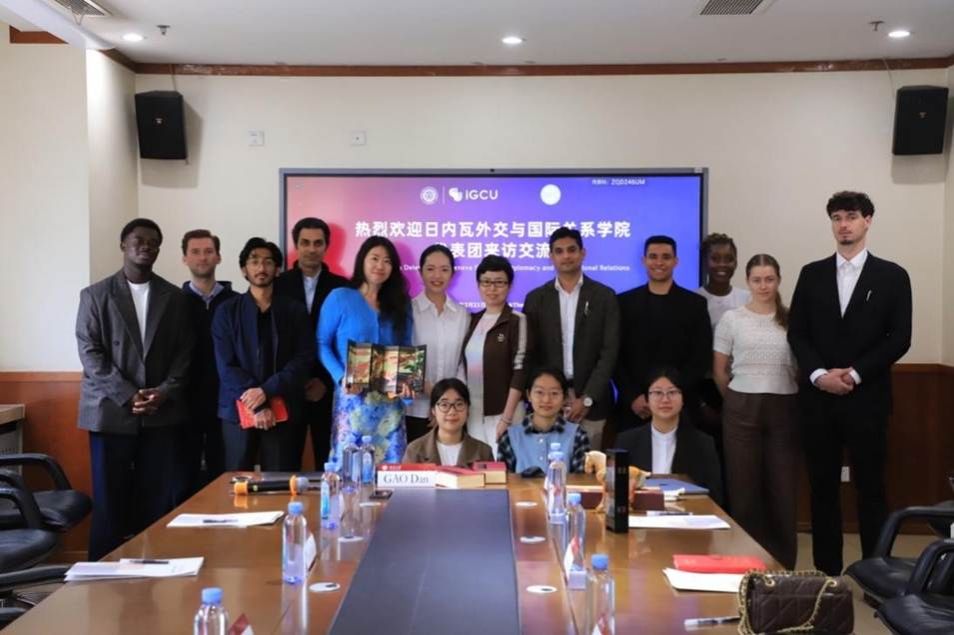
On May 21, 2026, a delegation of more than ten faculty members and students from the Geneva School of Diplomacy and International Relations visited the School of International Studies at Peking University. The event was jointly hosted by iGCU and the China Public Diplomacy Association. Dr. Gao Dan (Associate Research Fellow of the School of International Studies at Peking University) delivered a lecture titled “Chinese Cultural History.”
Dr. Gao began with the geographical origins of Chinese civilization and, following the historical trajectory of the Xia, Shang, Zhou, Qin, Han, Sui-Tang, Song, Yuan, Ming, and Qing dynasties, systematically reviewed the cultural development of China’s 5,000-year civilization. She focused on oracle bone inscriptions and the evolution of Chinese characters, the formation of Confucian and Daoist thought in the pre-Qin period, the unification of China under the Qin and Han dynasties and the opening of the Silk Road, Tang poetry and Tang sancai art, Ru ware porcelain and Along the River During the Qingming Festival of the Song dynasty, blue-and-white porcelain of the Yuan dynasty, Zheng He’s voyages to the Western Seas during the Ming dynasty, and Peking Opera art in the Qing dynasty. She also displayed miniature replicas and exhibits of cultural relics, including bronze ding vessels, oracle bone inscriptions, the Terracotta Warriors, Tang sancai pottery, Ru ware porcelain cups, and Peking Opera facial masks, allowing the guests to pass them around and experience Chinese cultural heritage up close. Dr. Gao noted that “harmony” is a core concept running through Chinese civilization. The Confucian ideal of “the world as one community” has shaped the distinctive character of Chinese civilization and continues to influence contemporary Chinese diplomatic thinking, finding clear expression and further development in the construction of a new type of international relations and the building of a community with a shared future for mankind.
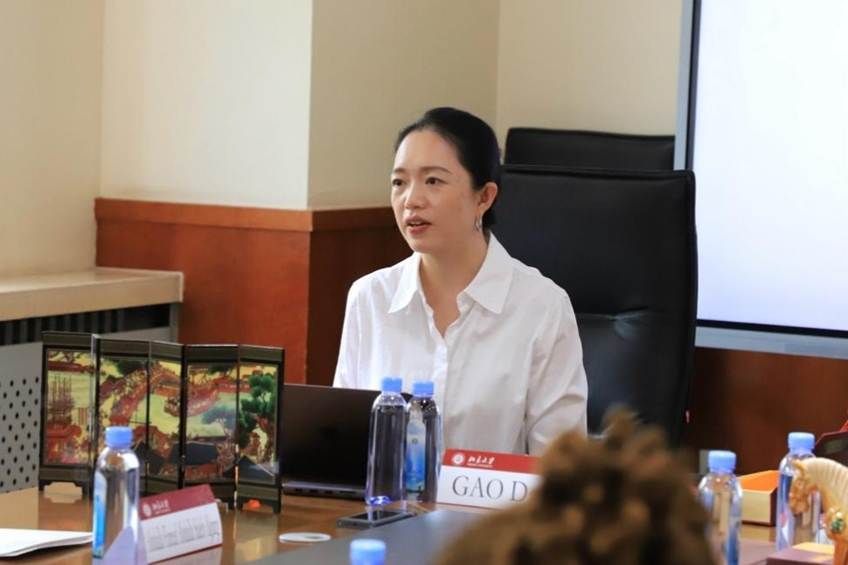
Dr. Gao delivering the lecture
During the interactive discussion, participants exchanged views on topics such as the role of Confucian and Daoist thought in contemporary Chinese society and political theory. One student described the defining feature of Chinese culture as “resilience,” noting that this resilience is reflected not only in the uninterrupted continuity of Chinese culture over more than 5,000 years, but also in China’s approach to a complex international environment: rather than adopting a confrontational “black-or-white” logic, China has consistently upheld the principle of mutually beneficial cooperation and sought space for coexistence. In response, Dr. Gao emphasized that China, with a population of 1.4 billion, takes pride in its progress and achievements while also recognizing and actively addressing the development challenges it currently faces. As an important contributor to global economic growth, China is constantly adjusting its role as a major country. Confucian and Daoist thought, as complementary cultural genes, continue to provide profound spiritual nourishment and cultural foundations for national development.
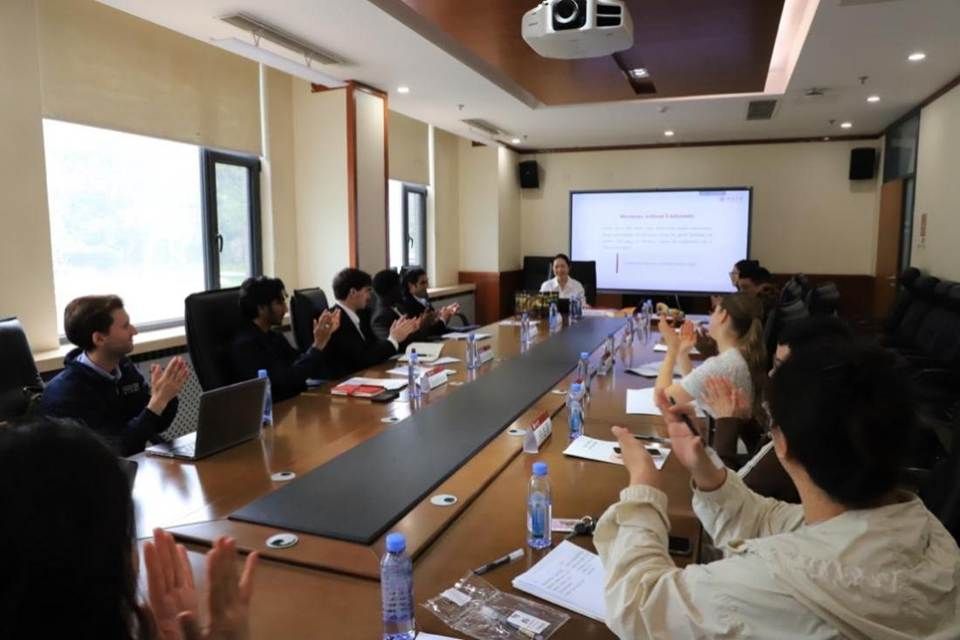
Exchange event
At the end of the event, participating faculty members and students took a group photo. With cultural artifacts as a medium and history as a mirror, the exchange offered visiting international students a valuable opportunity to gain a direct and vivid understanding of China’s cultural heritage. Through a dialogue between history and the present, participants not only deepened their understanding of China’s traditional wisdom of “harmony in diversity,” but also further recognized the profound cultural roots of contemporary Chinese diplomatic thought.
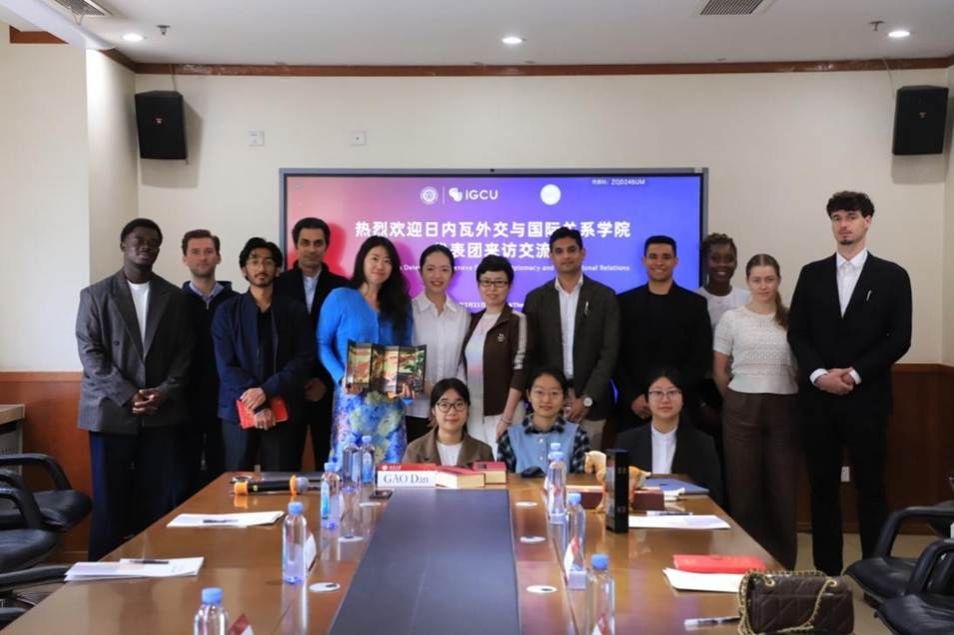
Group photo of participants







 Subscription