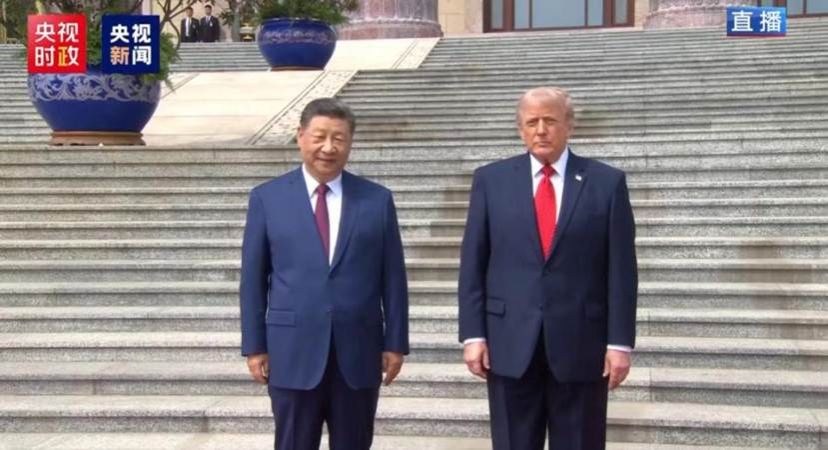
How does the head-of-state diplomacy shape #China-#US relations? What impacts will it bring to global governance and regional stability? What role does people-to-people exchange play in long-term bilateral stability? Professor Wang Dong from Peking University shares in-depth insights in an Exclusive Interview with China News Service @Echinanews.

China News Service reporter: How do you evaluate the historical weight and practical significance of this meeting between the Chinese and US heads of state? What role will the face-to-face communication between the heads of state of the two countries play in shaping the new era's model of coexistence between China and the United States and establishing the basic norms for major countries' coexistence?
Wang Dong: This visit to China by President Trump is the first by a US President in nine years. It holds significant historical weight, great practical significance and attracts high global attention. Over the past nine years, the world order has been profoundly reshaped, and the balance of power and interaction environment between China and the United States have undergone significant changes. The relations between the two countries have gone through ups and downs and now stand at a new critical crossroads. This summit meeting between the heads of state serves as the anchor for stability and the rudder for direction in China-Us relations. Its most significant value lies in bringing the relations between the two countries back onto the right track of dialogue rather than confrontation and coordination rather than conflict, and injecting certainty into a turbulent and changing world. Looking to the future, face-to-face communication between the heads of state of China and the United States will help jointly establish the basic norms for major countries to get along in the new era of mutual respect, peaceful coexistence and win-win cooperation, promote the healthy, stable and sustainable development of China-Us relations, provide the most crucial political guidance for the two countries to avoid strategic misjudgments, manage differences and expand cooperation, and also offer an important guarantee for world peace and development.
China News Service reporter: In your analysis, how does the current backdrop of intensified geopolitical conflicts and intertwined domestic contradictions in the United States affect the direction of the US policy towards China? In the medium and long term, what impacts will the domestic variables of the United States have on China-Us relations?
Wang Dong: In the long term, the pragmatic forces within the United States will still prevail: The deep entanglement of interests between China and the United States, the need for coordination in global challenges, and the unsustainable costs of confrontation and "decoupling" will eventually drive the United States' policy towards China back to rationality and reality. My overall judgment is that the internal affairs of the United States will cause fluctuations, but they cannot change the general direction of China-Us relations. The two countries will remain in a state of coexistence of competition and cooperation for a long time. It is an inevitable trend to manage risks amid differences and promote cooperation under common interests.
China News Service reporter: The world today is undergoing rapid changes over the past century, and conflicts in regions such as the Middle East are affecting the entire globe. In your opinion, what impact will this meeting between the Chinese and US heads of state have on hot issues such as global governance and regional conflicts?
Wang Dong: The China-Us relationship has long transcended bilateral ties and holds global significance. As major countries, China and the United States shoulder special responsibilities for global peace and stability. This meeting between the Chinese and US heads of state is conducive to restoring coordination and restarting cooperation between the two countries on major global issues such as global economic recovery, food security, energy security, anti-drug efforts, and artificial intelligence governance, and enhancing the effectiveness and fairness of global governance. On hot issues in regions such as the Middle East, maintaining communication and control between China and the United States is in itself conducive to cooling down risks, preventing the expansion of conflicts and promoting political settlement. Coordination among major countries is an important prerequisite for regional stability. The rational and controlling signals released by the meeting between the two heads of state will create favorable external conditions for regional detente.
China News Service reporter: This year marks the 55th anniversary of the "Ping-Pong Diplomacy" between China and the United States. You have long been concerned about the cultural and people-to-people exchanges between China and the United States. How do you evaluate the current situation, challenges and opportunities of such exchanges? What does people-to-people and cultural exchanges mean for the long-term, healthy and stable development of China-Us relations?
Wang Dong: People-to-people and cultural exchanges have always been the most dynamic, down-to-earth and solid foundation of China-Us relations. In November 2023, China proposed the initiative of "inviting 50,000 young Americans to China for exchange and study in the next five years". Over the past two years and more, more than 40,000 American teenagers have actively participated in the initiative. This fully demonstrates China's high regard for people-to-people friendship. At present, people-to-people and cultural exchanges between China and the United States are gradually picking up, and the opportunities outweigh the challenges. Despite political disruptions and the impact of the pandemic, the demand for exchanges between the people, academia, youth and business communities of the two countries remains strong and the foundation is still solid. The significance of cultural and people-to-people exchanges lies in breaking down the barriers between hearts, accumulating trust and goodwill, and providing the most enduring social support for China-Us relations. It is not about adding the finishing touch but about strengthening the foundation and nourishing the essence. Only when people get closer and hearts connect with each other can China and the United States have the most solid public opinion foundation for peaceful coexistence and win-win cooperation, and can the bilateral relations proceed steadily and far.








 Subscription