Chinese delegate directly questioned U.S. Secretary of Defense Hegseth during the 23rd #Shangri-La Dialogue over remarks by U.S. Forces Korea Commander Brunson on South Korea’s strategic status, sharply pressing him on the official #U.S. position. Representing Chinese scholars, Professor Wang Dong engaged in a pointed exchange with American officials at the international forum, drawing global attention. Brunson’s “dagger theory” and his ineffective defense of it also sparked widespread controversy in #South Korean society, and the South Korean government has expressed concerns to the U.S. side through diplomatic and security channels.

The 23rd Shangri-La Dialogue was held in Singapore from May 29 to 31. On the morning of May 30, during the first plenary session of the 23rd Shangri-La Dialogue, representatives from China and the United States engaged in a direct exchange. Gen. Xavier Brunson, commander of U.S. Forces Korea, recently described South Korea as “a dagger pointed at the heart of Asia and directed at China.” Prof. Wang Dong (Professor of the School of International Studies at Peking University; Executive Director of iGCU) sharply questioned the U.S. official position on Brunson’s remarks. U.S. Defense Secretary Pete Hegseth did not give a direct answer. Instead, he called on Brunson, who was also present at the scene, to stand up and respond in person.
During the Q&A session that morning, Prof. Wang directly addressed Hegseth. He noted that Gen. Brunson, commander of U.S. Forces Korea, had recently stated publicly that South Korea was “a dagger pointed at the heart of Asia and directed at China.” Wang asked: “This statement seriously contradicts the consensus you mentioned between the Chinese and U.S. heads of state on establishing a ‘constructive strategic stability relationship.’ President Trump has also repeatedly expressed his willingness to build the best possible China-U.S. relationship. Does General Brunson’s statement represent the official position of the Trump administration? Does the Pentagon endorse and acquiesce in defining South Korea as a strategic dagger aimed at China?”

Prof. Wang of Peking University’s School of International Studies, third from right, poses a question to U.S. Defense Secretary Pete Hegseth. Screenshot from the IISS livestream.
Faced with the question, Hegseth did not answer directly, but passed the microphone to Gen. Brunson, commander of U.S. Forces Korea, who was sitting in the audience.
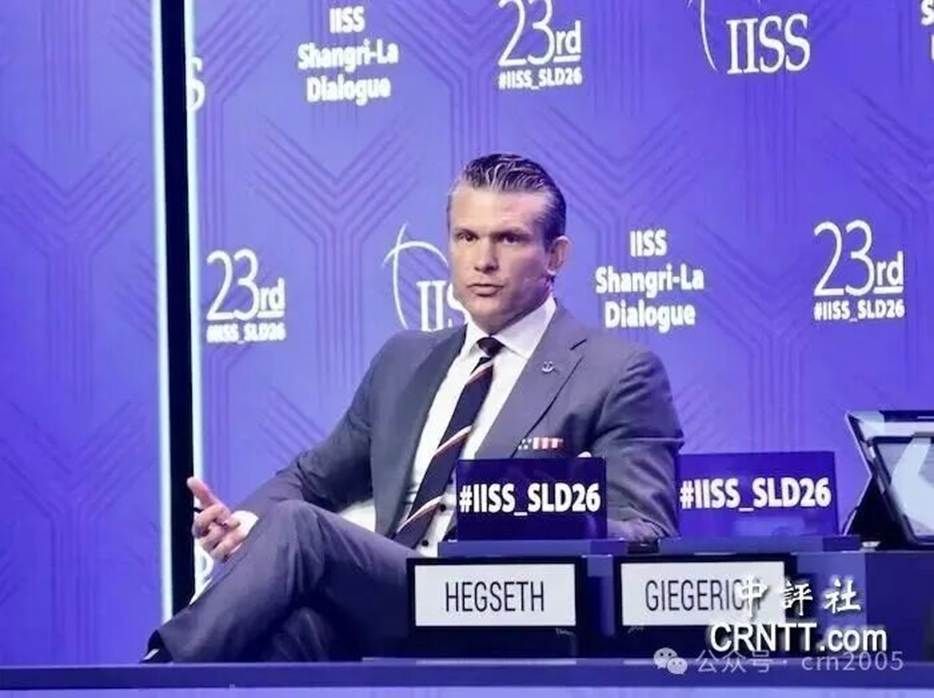
U.S. Defense Secretary Pete Hegseth did not directly answer Prof. Wang’s question. Photo by Chen Siyuan, China Review News.
Brunson argued that the relevant remarks were intended to explain the United States’ geostrategic operational environment and strategic perspective, rather than to make hostile comments directed at China. He claimed that the expression originated from a phrase circulated in Japan in the late 19th century, which described the Korean Peninsula as “a dagger pointed at the heart of Japan,” and that the “dagger theory” was not his own invention.

Gen. Xavier Brunson, commander of U.S. Forces Korea, responds to Prof. Wang’s question.
Prof. Wang’s exchange with the U.S. side at the international conference, representing Chinese scholars, attracted global attention and generated ripple effects across overseas media and online platforms. Media outlets including Singapore’s Channel News Asia, Canada’s Financial Post, and the English edition of the Global Times promptly reported on the incident.

A video of the exchange posted by CNA on Instagram received a high number of likes.
Brunson’s explanation also drew skepticism online overseas. Netizens were unconvinced by what they saw as his evasive and ambiguous attitude, arguing that his explanation did not directly answer Prof. Wang’s question.

Overseas netizens commented that Brunson’s explanation failed to answer Prof. Wang’s question. The comments were taken from the official CNA YouTube account’s comment section.
Meanwhile, in response to Brunson’s recent controversial remarks concerning South Korea’s geostrategic role, South Korean media outlets including Yonhap News Agency and The Chosun Ilbo reported on May 30 that the South Korean government had expressed concern to the U.S. side through diplomatic and security channels. The Chinese Embassy in South Korea also issued a stern response, stating that Brunson’s remarks had crossed the line.
The Hankyoreh commented that Brunson was, in effect, assigning roles to the United States’ two major allies in East Asia in containing China. South Korea was given an offensive role aimed at China’s “heartland,” while Japan was assigned a defensive role of preventing the Chinese navy from entering the Pacific. The newspaper said the remarks fully exposed Brunson’s so-called strategic thinking, in which South Korea is viewed as a forward military stronghold against China, while Japan is treated as a supporting defensive barrier.
As the controversy continued to escalate, the South Korean government communicated with the United States to convey its position. According to Seoul Economic Daily on May 30, South Korea’s National Security Office, Ministry of Foreign Affairs, and Ministry of National Defense had conveyed Seoul’s position to the U.S. side through multiple diplomatic and security communication channels. An official from the South Korean presidential office confirmed that the government had taken note of Brunson’s recent series of public remarks, and that South Korea and the United States were maintaining communication on the matter through channels at multiple levels. Maeil Business Newspaper analyzed that although the presidential office did not publicly disclose the specific content of the consultations, the fact that several South Korean diplomatic and security departments had simultaneously conveyed their position to the U.S. side was widely seen as a signal that the South Korean government had, in effect, expressed regret and concern over Brunson’s remarks and had asked the U.S. side to exercise restraint.
Yonhap News Agency reported on May 30, citing Boo Seung-chan, spokesperson for the ruling Democratic Party of Korea, that Brunson’s remarks had failed to give sufficient consideration to South Korea-China relations and South Korea’s own diplomatic circumstances, while unilaterally highlighting the U.S. strategic position. Boo said that Brunson’s arbitrary definition of South Korea’s strategic role could not only damage South Korea’s national sovereignty, but also further heighten regional tensions.







 Subscription