Can China and the United States overcome the Thucydides Trap and create a new paradigm of major-country relations? Can we jointly address global challenges and bring greater stability to the world? Can we work together to forge a promising future for bilateral relations for the well-being of both peoples and the future of humanity?
These three questions, which bear profound significance for history, the world and all people, were raised by President Xi Jinping during his meeting with President Trump on May 14. Professor Wang Yong of Peking University offered in-depth analysis on these topics in an exclusive interview with Wen Wei Po.

The question vital to history: Can China and the United States overcome the Thucydides Trap and create a new paradigm of major-country relations?
Answer from China: President Xi noted that China and the United States have more common interests than differences. Success in one is an opportunity for the other, and a stable bilateral relationship is good for the world. China and the United States should be partners instead of rivals. The two countries should help each other succeed and prosper together, and find the right way for major countries to get along well with each other in the new era.
Attitude from America: President Trump said that he will work together with President Xi to strengthen communication and cooperation, properly handle differences, make bilateral relations better than ever before and embrace a fantastic future.
Prof. Wang Yong: China has consistently been committed to building a new type of major-country relationship and has introduced relevant measures. At the conceptual level, China has successively put forward ideas such as “harmonious world” and a “new type of major-country relationship” to guide the management of international relations and address and overcome the challenges posed by the Thucydides Trap. In this new era of economic globalization and mutual interdependence, China’s new concepts and policies represent a path for major ccountries to coexist, further promoting the stable development of major-country relations and curbing vicious competition among them. Domestically, China continues to expand high-level opening-up and uphold the correct direction of economic globalization. On the diplomatic front, it has put forward the concept of a community with a shared future for mankind to reform and improve the global governance system. In recent years, China has also successively proposed four major global initiatives, continuously enriching practical measures for major power relations and global governance.
The challenges and issues currently faced stem primarily from the United States, which, in order to maintain its hegemonic status, has pursued a strategy of great power competition and designated China as its primary target. The Biden administration has sought to establish a new security framework targeting China to curb its development, while simultaneously pursuing economic decoupling and supply chain disruption against China.
Regarding the so-called “Thucydides Trap,” Chinese leaders have repeatedly stated in communications with their U.S. counterparts that the Thucydides Trap is not inevitable, and that China and the U.S. can reduce the risk of accidental conflict by establishing a crisis management mechanism. Since 2021, the President has proposed three principles for managing U.S.-China relations: mutual respect, peaceful coexistence, and win-win cooperation. Mutual respect entails respecting each other’s core interests, treating one another as equals, establishing red lines in key areas such as the Taiwan issue, and avoiding the risk of conflict. Peaceful coexistence involves improving crisis management mechanisms, preventing the escalation of friction between the two sides, and committing to peacebuilding. Win-win cooperation mean, on the basis of managing differences, focusing on areas of shared interest, fulfilling the responsibilities of major powers, expanding the scope of bilateral cooperation, and solidifying the foundation of China-U.S. relations.
The leaders of China and the U.S. have engaged in repeated communications and meetings, culminating in the establishment of a constructive China-U.S. relationship of strategic stability as the new positioning of China-U.S. relations. In the context of China-U.S. competition and strategic maneuvering, China, on the one hand, proactively presents facts and reasoned arguments to deepen the U.S. understanding of China’s culture of peace; on the other hand, in response to U.S. suppression and sanctions, China must take resolute countermeasures, leveraging its own strengths in areas such as rare earths and supply chains to respond in kind to U.S. tariff sanctions, ultimately leading the U.S. to recognize China as a competitor of equal strength. The United States pursues a realist foreign policy. By drawing on its comprehensive national strength and firm stance, China has earned the respect of the United States, effectively promoting the establishment of a new framework for a constructive relationship of strategic stability between the two countries, and helping to advance the implementation of a new type of major-country relationship.

The question vital to the world: Can we meet global challenges together and provide greater stability for the world?
Answer from China: President Xi noted that China-U.S. relations concern the well-being of the over 1.7 billion people of both countries and affect the interests of the over 8 billion people of the world. He said both sides should rise up to this historical responsibility and steer the giant ship of China-U.S. relations forward steadily and in the right direction.
Attitude from America: President Trump noted that the U.S.-China relationship is the most consequential bilateral relationship in the world, and the two countries should strengthen cooperation to create a better future for the world.
Prof. Wang: In the face of global challenges, China advocates that major powers should shoulder their responsibilities and demonstrate the sense of responsibility befitting their status. Cooperation between China and the United States can achieve many significant, positive, and practical outcomes for the world. In addition to epidemic prevention and control and promoting global development, China and the United States can also engage in extensive cooperation in areas such as reducing regional differences and disputes and maintaining regional peace and stability.
Regarding the challenges ahead, judging from the current situation, the United States is more focused on its own interests. The Trump administration has pursued the America First policy, abandoning multilateralism in favor of unilateralism, and is unwilling to shoulder excessive international responsibilities, viewing such responsibilities as allowing other countries to take advantage of the United States. Therefore, it is not easy for China and the United States to engage in genuine, in-depth, and substantive cooperation at this stage.
However, the U.S. faces disagreements domestically; there are still forces within the country dedicated to advancing climate governance and upholding global peace and development. China should engage in broad outreach with American society to help the U.S. elite and the general public develop a correct understanding of international cooperation. Given time and sustained effort, China and the U.S. can be expected to achieve certain cooperative outcomes in relevant fields
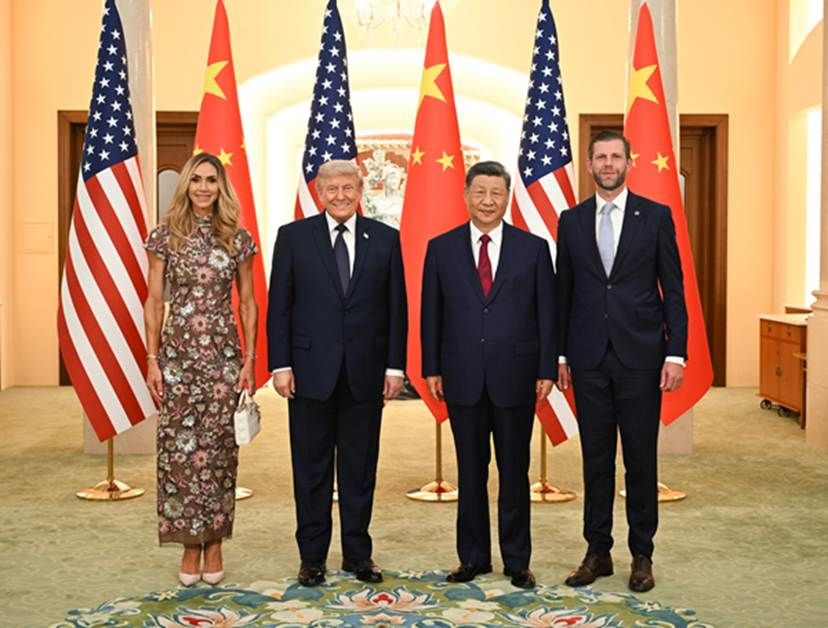
The question vital to the people: Can we build a bright future together for our bilateral relations in the interest of the well-being of the two peoples and the future of humanity?
Answer from China: President Xi noted that the peoples of China and the US are both great peoples. Achieving the great rejuvenation of the Chinese nation and making America great again can go hand in hand. China and the United States can help each other succeed and advance the well-being of the whole world.
Attitude from America: President Trump said the people of the US and China share mutual appreciation and respect, and their friendship goes back a long way.
Prof. Wang: With an eye toward a brighter future for the world, China and the United States can take concrete actions in multiple areas to jointly build a peaceful, stable, and prosperous world.
First, we must affirm our shared human values and view the world as a “global village” with a shared future. We all aspire to benefit from a fair, inclusive, and just order. We should set aside and eliminate ideological biases and differences, build consensus on shared values, and reject notions of civilizational or racial superiority.
Second, we must jointly practice multilateralism, uphold the international system with the United Nations at its core, and safeguard the hard-won achievements in global governance since World War II.
Third, we should deepen cooperation on various global and non-traditional security issues, and strengthen collaboration in areas such as public health, cross-border drug control, and environmental governance.
Fourth, we should jointly uphold the free trade order in the economic and trade sphere, strike a balance between job creation, sustainable development, and free trade, and promote the development of economic globalization in the new era. China and the United States can play a leading role in this regard.
Fifth, we should promote people-to-people exchanges and mutual learning among civilizations, regularly organize more exchange activities, and enhance interactions between the peoples of our two countries.
During this meeting between the leaders of China and the United States, consensus was reached on multiple issues in the aforementioned areas, including continuing to implement all agreements reached in previous consultations, agreeing to establish a Trade Council and an Investment Council, addressing each other’s concerns regarding market access for agricultural products, and promoting the expansion of two-way trade within a framework of reciprocal tariff reductions. We must resolve trade disputes through dialogue rather than unilateral measures, and work to bring China-U.S. relations back onto a track of institutionalized engagement. The key next step lies in implementation and ensuring that the framework for a constructive relationship of strategic stability agreed upon by the two heads of state is fully realized. Both sides must move toward each other and work together to promote the well-being of the people of China and the United States, as well as the people of the world.








 Subscription