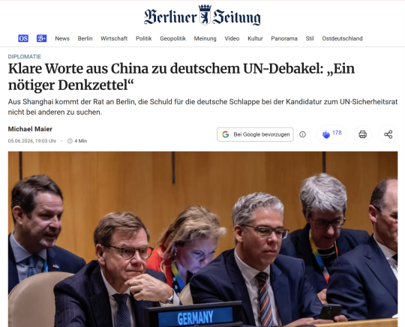
On June 3 local time, Germany failed in its bid for a non-permanent seat on the UN Security Council, sparking widespread discussions over its foreign policy. In a recent exclusive interview with Germany’s Berliner Zeitung, Research Fellow Jiang Feng from the SAGGAS, stated that the outcome serves as a warning signal from the international community.
Germany’s failed bid for a non-permanent seat on the UN Security Council has come as a “great surprise” to Chinese observers. In an interview with the Berliner Zeitung, Jiang Feng, Research Fellow at the Shanghai International Studies University (SISU) and Chairman of the Shanghai Academy for Global Governance and Area Studies (SAGGAS), expressed his hope that “this result will serve as the starting point for a debate on German foreign policy, one that will earn Germany the recognition it deserves on the world stage—a recognition beneficial not only to Germany but to the entire world.”
He argued that the defeat amounts to a “wake-up call” for Germany’s foreign policy in recent years, as well as “a useful opportunity for self-reflection and thorough analysis.”
Jiang cautioned that Germany must now avoid the mistake of “looking for scapegoats”—such as criticizing Chancellor Friedrich Merz as a “foreign policy chancellor,” claiming the application was submitted too late, arguing Portugal enjoyed greater support in Latin America due to its colonial past, or that Austria, as a neutral state hosting numerous UN agencies in Vienna, had an unfair advantage. He even dismissed suggestions that Russia and China had deliberately backed Austria.
“Shifting blame will only lead Germany astray,” he said. “Now is the time to reexamine, and even rethink, Germany’s own foreign policy and diplomatic style.”
Jiang believes the international community no longer trusts Germany’s foreign policy. In recent years, Germany has “massively increased military spending while cutting funds for development aid and climate protection.”
“This approach contradicts Germany’s own values,” he pointed out. “The impression that Germany has failed to keep its promises to the global community on development cannot be dispelled.”
Accordingly, Germany’s defeat reflects deep disappointment among Global South nations with its foreign policy. For years, Germany has cast itself as a “role model” striving to “steer the world toward good”—a stance that underpins its much-criticized moralistic foreign policy, which reached its peak under former Foreign Minister Annalena Baerbock.
Ironically, it was Baerbock, in her capacity as President of the UN General Assembly, who “had to announce Germany’s defeat in the New York vote”—a detail Jiang could not resist highlighting.
Faced with complex geopolitical realities, idealism alone is insufficient. Jiang criticized: “Against the backdrop of the Ukraine conflict, the Gaza crisis, and tensions with Iran, Germany’s moralistic foreign policy has proven inconsistent. Critics therefore label it ‘moral opportunism.’”
While Berlin has “good reason to repeatedly emphasize its historical responsibility for Israel’s security,” Jiang told the Berliner Zeitung, “many countries and their people worldwide cannot understand why this historical duty should serve as justification for inaction amid wars and humanitarian disasters in the Middle East.”
Foreign policy requires “consistency, especially when it comes to morality.” A world without morals and values would be “hell.”
“By definition, morals and values apply equally to all people and all nations,” he stressed. “If this cannot be upheld, restraint is needed to avoid falling into the self-imposed trap of moral opportunism.”
Jiang also cited a key example of Germany’s failure to live up to its role as a role model: its decision to run in the election at all.
“Europe expects Germany to show leadership, for instance in coordinating European candidacies for the Security Council to avoid direct competition among EU states and strengthen European solidarity,” he said. “Yet Germany chose to compete directly with Portugal and Austria—hardly demonstrating the coordination skills expected of an EU leader.”
Germany “finished far behind Portugal and Austria in the vote count,” Jiang noted. His conclusion: “This result is an unpleasant but necessary wake-up call that the international community has delivered to German foreign policy.”






 Subscription